{{ item.title }}
Our No: {{ item.sku }}
{{ item.price }}
Your basket is currently empty


On our website, you can add items to the cart and request either a quotation or a pro-forma invoice. To request a quotation or pro-forma invoice simply add your items to the cart and select ‘Request a Quotation’ or ‘Request a Pro-Forma’ at checkout. Payment details are not required.
One of our team will contact you with a competitive offer including delivery to your destination.
In the majority of instances, electrical connectors are categorised as either ‘male’ or ‘female’. However, when it comes to Powerlock connectors, the ‘gender’ of these products is designated as either ‘Source’ or ‘Drain’, and the specific application for each is as follows:
The source connectors are intended to have their permanent connection at the supply of electrical energy (such as a connection to the electrical grid or an emergency generator), and the drain connectors are intended to have their permanent connection at the equipment receiving power. The role of male and female connectors is opposite to traditional usage in other designs of power connector- the Powerlock source connector has a male pin and the drain connector has a female receptacle. This does not however, compromise safety because the gap between the plastic insulating cap on the male pin of the source connector and the surrounding plastic housing is too small to insert a human finger. The female drain connector also has a spring-loaded plastic cap to prevent dirt ingress and casual contact with the electrical contact; however with sufficient pressure this can be displaced with a finger.
All Powerlock connectors of any brand are built under the same product patent. As such, all brands will mate together. Therefore, you can safely use Powersafe or PowerSyntax Powerlock Connectors with any other esablished brand of Powerlock.
Powersafe Powerlock in-line connectors are designed to suit 10 different cable sizes, from 25mm2 to 300mm2 CSA. Powersafe Powerlock connectors are available in either set screw termination for cables up to 150mm2 or crimp termination for cable sizes between 150mm2 & 300mm2.
When selecting Powerlock connectors It's the cable size, cross-sectional area (CSA), that determines which in-line connectors are required. The 500A set screw 120mm2 M40 connectors; for example, are typically used for all cable sizes between 25mm2 & 150mm2 with all other larger sizes moving to crimp termination. A series of adapter bushings are available between 25mm2 - 95mm2 which can reduce the set-screw contact to suit the diameter of the cable being installed. For cable size 185mm2 240mm2 & 300mm2 simply choose the connectors with the appropriate crimp size to fit the cable.
It's the cable size, cross-sectional area (CSA), that determines which in-line connectors are required:
The relevant Amperages in relation to cable size for Powerlocks is listed below:
35mm2 = 169Amps
50mm2 = 207Amps
70mm2= 268Amps
95mm2 = 328Amps
120mm2 = 382Amps
150mm2 = 441Amps
185mm2 = 506Amps
240mm2 = 599Amps
300mm2 = 693Amps
We keep a wide variety of the most popular Powersafe Powerlock Connectors on the shelf as standard, with cable terminations from 120mm2 up to 300mm2.
The most popular products are the M40A 120mm2 Set Screw Connectors, which are designed to be used with 120mm2 cable and terminate using a set screw contact. However, unlike other Powerlocks in the range, it can also accept most types of 150mm2 H07RN-F as well.
For applications that require a cable size smaller than 120mm2, the set screw 120mm2 product allows you to add reducer kits into the connector to terminate to cable sized from 25mm² to 95mm². These must be purchased separately and are available here.
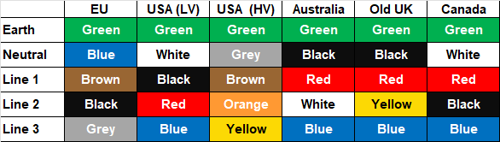
Powerlocks are single-pole devices, and each line is represented by a distinct colour. Powerlocks are widely used globally, and the below chart illustrates the colour assigned to each specific line in the various regions. Earth is always Green & Neutral is not used in every case.
EU colours are Green/Blue/Brown/Black & Grey. EU Colours, Brown (L1), Black (L2), Grey (L3), and Blue (Neutral) with Green for Earth.
Old UK Colours are still widley used in many countries outside the EU and consits of Green/Black/Red/Yellow & Blue. Example: Old UK Powerlock colours for 3-phase systems use Red (L1), Yellow (L2), Blue (L3), and Black (Neutral), with Green/Yellow or bare copper for Earth. These legacy colours remain in use for compatibility with older installations and are distinct for each phase in professional power distribution.
Please refer to the International colour chart below for your reference. This chart will assist you in determining the appropriate colour for your requirements.
When did the colour coding of electrical wiring in the United Kingdom change?
In March 2006, the United Kingdom government introduced an amendment to British Standard BS 7671 (Requirements for Electrical Installations). This amendment resulted in a significant change in the colour coding of electric cables, considered one of the most notable developments in the electrical industry’s modern history. The revised wiring regulations aimed to harmonise the UK wiring colours with those of European cables, thereby promoting consistency and reducing confusion. The previous cable plug colour codes did not adequately account for phase rotation, necessitating the adoption of IEC (International Electrotechnical Commission) wiring colour codes for AC circuits by the majority of Europe.
The P3 Powersafe Reduction Kit is for use with the standard P3 Powersafe Set Screw Connector M40 (120mm²). The reduction kit contains a series of 5 reducer sleeves that are used to reduce the Set Screw Connector 120mm² (S120) cable bucket in the rear of the contact.
The P3 Powerlock reduction kit will allow the termination using Single Core power cable sized from 95mm² down to 25mm².
The Powersafe reduction kit codes:
Set Screw 95mm² Reduction Sleeve (R95) Code: 8349
Set Screw 70mm² Reduction Sleeve (R70) Code: 8350
Set Screw 50mm² Reduction Sleeve (R50) Code: 8358
Set Screw 35mm² Reduction Sleeve (R35) Code: 8853
Set Screw 25mm² Reduction Sleeve (R25) Code: 8854
When the Powerlock in-line Source & Drain connectors are mated, they cannot be accidently disconnected. This firm locking together of the connectors is what gives them their Powerlock name. The only way to disconnect the locking pin is to use a Powerlock release key. These can be supplied alongside connectors in customer specified colours, Green as standard.
If you have any questions about our Powerlock connectors and how they work, please get in touch.
MCB = MINIATURE CIRCUIT BREAKER
Miniature Circuit Breakers are designed to protect people, cables and equipment from two main types of fault:
(A) Overloads: the gradual build-up of heat due to increasing current flowing through a circuit. A thermal device in the MCB detects this build-up and trips the MCB. The speed of this depends upon the severity of the overload and the tripping curve of the MCB as indicated below.
(B) Short circuit: sudden increases in current flowing through a circuit causes a magnetic device in the MCB to operate in a fraction of a second, protecting the installation and any persons in contact with the supply.
The correct tripping curve of the MCB depends upon the type of equipment being protected. For example, florescent lighting and motors can cause an initial surge on start-up which may cause nuisance tripping with a B Curve MCB, therefore a C Curve MCB should be installed. If this is still inadequate then a D Curve should be selected. Our standard distro boxes are fitted with Type C.
RCD = RESIDUAL CURRENT DEVICES
RCD’s work on the principle of a load being in balance – that is, the current on the Phase conductor is equal to that flowing out of the Neutral conductor. The Phase and Neutral cables in an RCD pass through a magnetic ring which detects any imbalance. If equal, the RCD remains operational, if imbalanced it causes the mechanism to trip.
Modular RCDs come in 2-pole and 4-pole versions. 2-pole versions are usually mounted in consumer units to protect a number of circuits at once. However, both 2-pole and 4-pole versions can be used separately as protection devices in enclosures. Our standard distro boxes are fitted with Type A RCD
There are two usual ways in which an imbalance of the load can occur:
Indirect Contact: defined in the IEE Wiring Regulations as ‘contact of persons and livestock with exposed conductive part made live by a fault which may result in an electric shock e.g. the casing of an appliance or motor.
Direct Contact: defined in the IEE Wiring Regulations as ‘contact of persons and livestock with live parts which may result in an electric shock.’ e.g. exposed damaged cable. In both cases RCDs should not be the only method of protection used - see BS7671 wiring regulations for further information. To provide all-round protection RCDs must be used in conjunction with suitable MCBs.
RCDs are available in the following sensitivities:
30mA the most popular sensitivity in the UK. In a shock, current flowing through body at 240V could be 80 to 240mA, depending on the resistance of the body in question. To ensure no harmful effects the RCD operates within 300mS at 30mA and 40mS at 150mA.
100Ma may provide protection against electrocution. However, there is a likelihood that the earth fault current may be below the sensitivity of the RCD - increasingly likely if additional resistances to that of the human body are in the current path.300mA - provides protection against risk of fire only, not against electrocution in shock situations. A typical application is lighting circuits where risk of electric shock is small. Note, a current of <500mA flowing in a high resistance path is enough to cause metallic parts to potentially start a fire.
RCBO's = RESIDUAL CURRENT DEVICES + MINIATURE CIRCUIT BREAKER
RCBO’s are a combination of an RCD and MCB in one unit. This enables both over-current protection and earth fault current protection to be provided by a single unit, which allows earth fault protection to be restricted to a single circuit, ensuring only the circuit with the fault is interrupted, limiting inconvenience tripping of many circuits. As standard, our boxes are fitted with 30mA Type “C” Curve 2 Pole RCBO Type A ( AC + Pulsating DC )
Two versions are available:
1 module 1 pole version (17.5mm wide). Although the same width as a standard MCB it is twice the height. Ideal for use in consumer units where more control is required as to which circuits are protected by RCDs and which by RCBOs, as individual circuits can be protected as opposed to groups of circuits in a standard split-load consumer unit.
Standard 2 Module RCBO (35mm wide). These usually switch both the live and the neutral connections
Historically, all of our RCD's/RCBO's have been type AC as the majority of use cases have been with alternating current. However, due to changes with many regulations in EU countries regarding type AC and the increasing popularity of battery based technology, the majority of our distro will now come with type A breakers ( As standard, our boxes are fitted with 30mA Type “C” Curve 2 Pole RCBO Type A ( AC + Pulsating DC ). This will ensure that our power distrubution equipment meets the standards within the EU and also to accommodate the increasing usage within DC environments. For further technical details, please read the excerpt below.
This explanation focuses on the changes introduced in Amendment 2 to BS 7671:2018 in respect to testing of RCDs (RCCBs & RCBOs as they are more commonly known), it also addresses a number of common questions relating to RCD technology
The early style Residual Current Devices (RCDs) were highly effective protective devices but they have proven to be less reliable in modern buildings as a consequence of DC leakage and DC fault currents caused by electronic equipment. Subsequently, new types of RCD have been developed.
The amendment 2 to BS 7671:2018 in respect to testing of RCDs (RCCBs & RCBOs as they are more commonly known), it also addresses a number of common questions relating to RCD technology.
Regulation 531.3.3 of BS 7671:2018+A2:2022 states that the appropriate RCD shall be selected according to the presence of DC components and AC frequencies. Further, Type AC RCDs shall only be used to serve fixed equipment, where it is known that the load current contains no DC components.
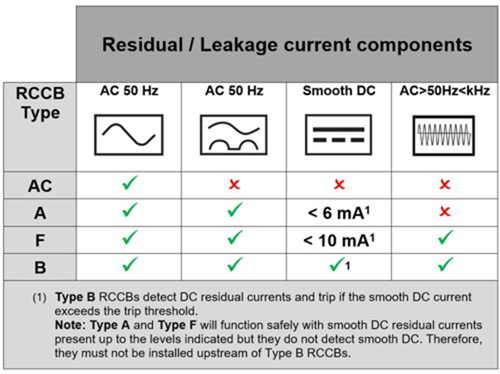
Type AC RCDs are affected by residual DC components and can become desensitized or ‘blinded’ and may not operate within the required time or, in some instances, may not operate at all. Table 1 summarizes the various types of RCD referred in BS 7671:2018+A2:2022 and their resilience to DC components.
Given the prevalence of electronic equipment in most installations, it is difficult to see how the electrical designer will be able to justify the use of Type AC RCDs. Many manufacturers have discontinued Type AC RCDs, preferring to supply type A as a minimum. Therefore, in future it is possible that Type AC RCDs will become obsolete due to lack of demand and Type A RCDs will become the common choice for most new installations, so it is important to understand the changes to the requirements for RCD testing.
See the chart below:
We offer custom-made power distribution boxes in various configurations, including rubber, thermoplastic, polypropylene, and steel frame options.
Additionally, we can custom-make cables to meet your specific requirements.
Please contact us to discuss your needs, and we will gladly provide you with a quotation.
Once you have identified your desired products and added them to your basket, proceed to the checkout and select ‘Pay By Pro-Forma Invoice’. Our team will promptly contact you to provide a Pro-Forma Invoice that includes the international shipping costs and the applicable product quantity discount. We utilise DHL and FedEx for shipping to over 50 countries globally.
If you have decided against making an online purchase through our website and prefer to transact with us in a traditional manner, we can provide you with a secure link to facilitate payment via card services such as Mastercard, Visa, ApplePay, Google Pay, and others. Alternatively, you can initiate a payment via BACS by providing the details located at the bottom of our invoice.
Please be advised that if you choose to pay via BACS, our account currency is GBP (£). We require all charges to be settled by the sender to ensure that the amount received aligns with the invoice value.
Cyber Crime Alert
Please be vigilant against potential scams. We will not send you our bank details via email, as emails are not a secure method of communication. Do not rely on email notifications of bank details or changes without direct verbal confirmation from a trusted source. For clarification, please contact our main number. We will not accept responsibility for any funds transferred to an incorrect bank account. We bank with HSBC PLC, and our sort code is 40-38-04. Please contact us to confirm our account number, which concludes with xxxxx733.
To convert kilovolt-amperes (kVA) to amperes (A), you need to know the voltage (V) and the power factor (PF) of the load. The formula to convert kVA to amps is:
Amps = (kVA × 1000) / (Volts × Power Factor)
To convert 1 kVA to Amps at 240V Single Phase with a power factor of 0.8:
Equation 1kVA: (1 × 1000) / (240 × 0.8 =192 ) 1000 divided by 192 = 5.21 Amps
Equation 5 kVA: (1 × 5000) / (240 × 0.8 =192 ) 5000 divided by 192 = 26.041 Amps
Simple Example for: 3Phase
Your distro box is 63Amps 400v
Equation: 63 x 400 = 25,200 x this by a factor of 1.73 = 43.596 kVA
Your distro box is 125Amps 400v
Equation: 125 x 400 = 50,000 x this by a factor of 1.73 = 86.500 kVA
See a useful link below: https://www.rapidtables.com/calc/electric/kVA_to_Amp_Calculator.html
BS 7671, also known as the IET Wiring Regulations, is the UK’s national standard for the design, erection and verification of electrical installations.
It brings together European (CENELEC) Harmonized Documents and international standards (IEC) to provide a single, authoritative reference for safe, compliant electrical work across domestic, commercial and specialized environments.
Amendment 4:2026 introduces essential updates that reflect modern technologies including electrical energy storage, ICT systems and Power over Ethernet, ensuring installations meet today’s technical and safety expectations.
BS 7671 is directly relevant to:
It is also highly relevant to manufacturers and suppliers of electrical equipment, such as cables, luminaires, sockets, consumer units and safety equipment. The standard is essential for anyone involved in the design, installation, inspection and testing of electrical systems in domestic, commercial and specialized environments.
With almost 50% of electrical installers planning to undertake solar, EV charging and heat pump installations, staying current with BS 7671 is how you lead in a fast-changing market.
BS 7671 covers the requirements for:
Amendment 4:2026 specifically introduces:
Knowledge isn’t optional, it’s your edge. BS 7671 and its supporting guidance give you the confidence to deliver, win more work and lead in an evolving industry.
BS 7671:2018+A4:2026 supersedes BS 7671:2018+A2:2022+A3:2024, which will be officially withdrawn on 15 October 2026 but remains valid for six months after Amendment 4’s April 2026’s release.
The key changes introduced in this amendment include:
Sending heavy and/or large items cannot always be done using a standard delivery service, so if you have large goods to send, you’ll want to consider palletised freight. We understand that knowing which pallet size to use can be confusing, that’s why we’ve created this easy-to-follow guide detailing the different pallet size options.
UK pallet size and Euro pallet size are usually the same, standardised dimensions: once the pallet measures within 120(cm) x 100(cm) x 220(cm) it is being classed as a standard pallet in the UK and Europe.
UK (Standard): 1,200 × 100 mm x 220mm (47.2 x 33.3 inches).
Europe (EUR/EPAL): 1,200 × 800 mm (47.2 × 31.5 inches).
Asia: 1,100 × 1,100 mm (43.3 × 43.3 inches).
North America: 48 × 40 inches (1,219 × 1,016 mm), commonly known as the GMA pallet.
Australia: 1,165 × 1,165 mm (45.9 × 45.9 inches).
Within standard UK and euro pallet dimensions, we can book a half, quarter or full pallet, depending on your needs. The size classification is determined by the height of the goods; the length and width remain the same (refer to the above).
 Spend £100 or over to qualify for free delivery!
 Not in the UK? Contact us for overseas pricing and delivery charges